Tennibot Partner Lite Review: A $1,495 AI Tennis Ball Machine That Stays Put
ARA Gear Review Staff
9 min read
By the ARA Gear Review Staff. Tested on court in August 2026.
The short version
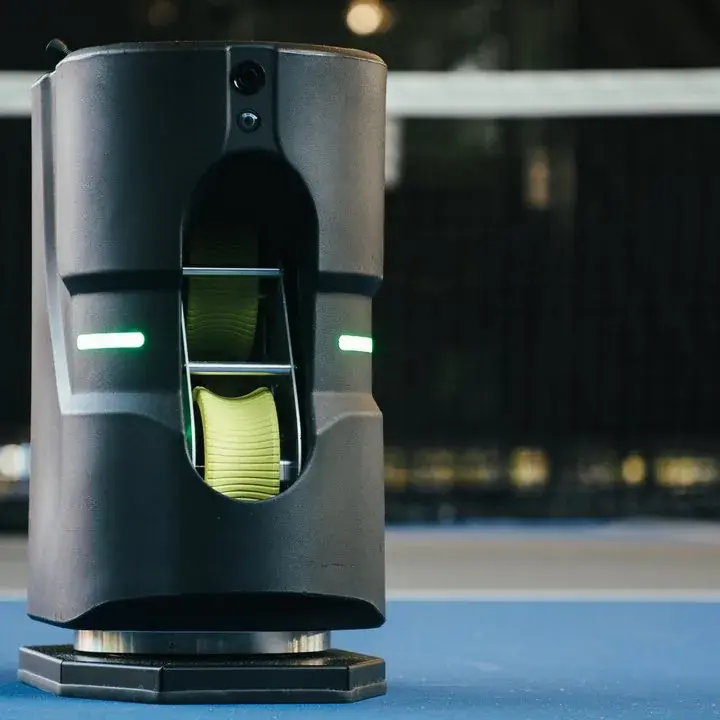
The Partner Lite is the Tennibot Partner with the drive base taken out. Same AI, same app, same custom drills, same spin and placement control, same 60-day trial and 3-year warranty. What it does not do is move around the court. It weighs 25 lbs and it costs $1,495.
That is the entire decision. If you want AI-built drills and you do not need the machine chasing you around, this is the most capable stationary machine we are aware of at the price.
🏆 Best stationary machine with real training software — Tennibot Partner Lite, $1,495
⚖️ Lightest machine with on-board AI — 25 lbs, against a field that mostly runs 39 to 46 lbs
🚫 Not for you if — you specifically want the machine to move you side to side and forward and back
What the Partner Lite actually is
In our tennis ball machine guide we gave the Tennibot Partner our Best Overall (Smart/AI) pick, and in our pickleball guide we did the same. Both times we noted the same caveat: it costs meaningfully more than the traditional machines it sits next to.
The Partner Lite is Tennibot's answer to that objection, and it is a more interesting answer than we expected. This is not a stripped-down cousin built on cheaper internals. It is the same machine with exactly one subsystem removed, the drive base that lets the Partner V2 roll around the court. The launcher, the app, the AI drill engine, the spin and placement control, the Apple Watch support, the over-the-air updates and the warranty all carry over unchanged.
One physical unit covers tennis and padel. Pickleball is a separate unit.
Tennibot is also, as far as we can establish, the only company building AI-powered ball machines in the United States.
ARA CEO Shaun Boyce spent a session with the Lite during our testing. His read:
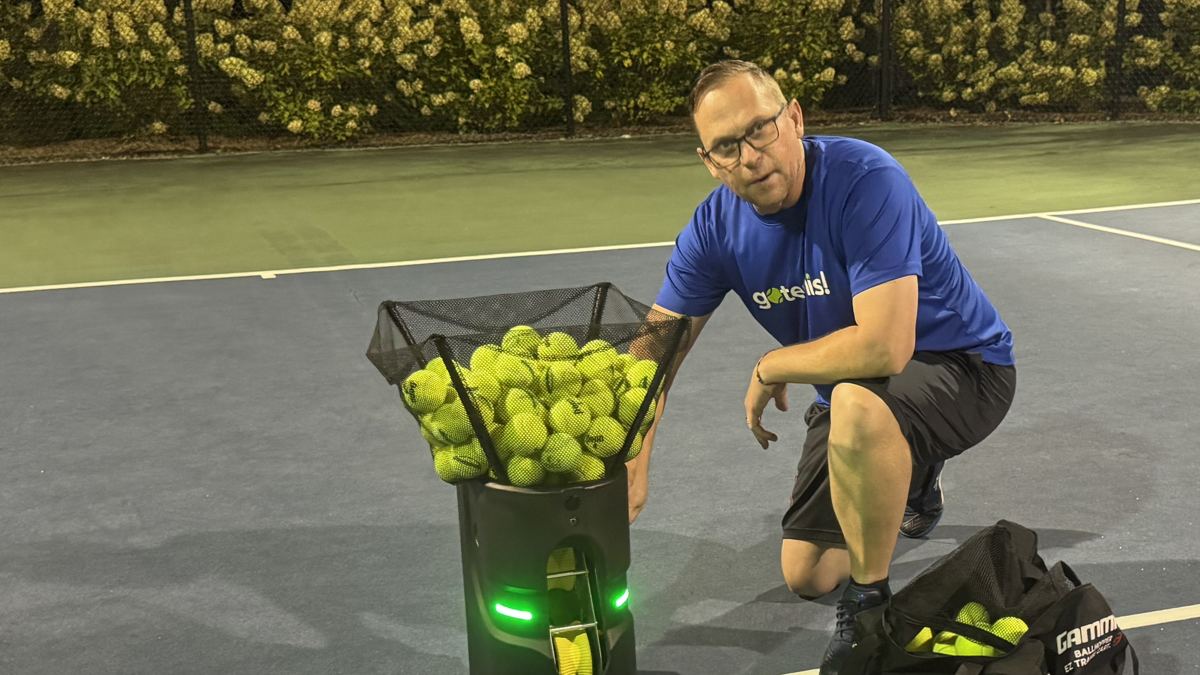
"I loved how portable and easy to operate the Lite is on the court. I think about the students and pickleball players and what they expect from a ball machine. I feel ease of use is often underrated in many ball machines, and the Lite gets it right. It doesn't show up on any spec sheet or comparison table, but at the end of the day, it's the number 1 thing many players care about."
— Shaun Boyce, CEO, American Racket Sports Association
What you keep
This is the part that makes the Lite worth writing about. On almost every other value model in this category, the cheaper machine is cheaper because the software is worse: fewer drills, a thinner app, less control. Tennibot went the other way and cut hardware instead.
What we like:
- AI custom drills. Tell it what you want to work on and it configures shot placement, pace and sequence for you, rather than making you hand-program every feed
- Full app control, plus Apple Watch. Start, pause and adjust from your wrist without walking back to your bag
- Spin and placement control. Topspin and slice, depth, angle, repeatable shot to shot
- Over-the-air updates. The machine you buy in September gets features added to it later
- 140-ball hopper. The same capacity as the Partner V2 in tennis trim
- 25 lbs. More on this below, because it is the most underrated thing about this machine
- Works with the Rover, Tennibot's autonomous ball collector
- 60-day risk-free trial, 3-year warranty, free US shipping and returns, made in the USA
Partner Lite, as published by Tennibot
| Spec | Value |
|---|---|
| Weight | 25 lbs |
| Dimensions | 15 × 10 × 19 in |
| Hopper | 140 tennis / 250 pickleball / 140 padel |
| Ball speed | 10–70 mph (65 mph pickleball) |
| Spin | 3,600 rpm |
| Feed rate | 2–15 seconds |
| Elevation | 16.5–37° |
| Battery | 4–5 hours, 90 min charge |
| Vision | 4K cameras, IMU, ultrasonic |
| Processing | 8 TOPS, on-device inference |
| Operating range | 15–110 °F |
What you give up
Movement. That is the whole list.
The Partner V2 drives around the court between feeds, which lets it put you under the kind of pressure a stationary machine structurally cannot: a ball from a different position every time, so you are reading and recovering rather than standing in one place hitting from a known angle. It is genuinely the thing that makes the V2 feel less like a machine, and it is why it holds our Smart/AI pick.
The honest question is how often you need that. Based on what most players and coaches actually do with a ball machine:
- You will not miss it if you are grooving a stroke, drilling volleys, working serve returns, feeding a lesson from the other side, running a clinic station, or building consistency at any level below competitive match prep
- You will miss it if you are training court coverage and recovery footwork, simulating a live opponent's court position, or preparing for tournament play where the ball comes from somewhere different every point
What we don't: nothing about the Lite's execution, but understand the trade. If court movement is why you were interested in Tennibot in the first place, the Lite doesn't move; it's a stationary ball machine.
The weight number deserves its own section
At 25 lbs, the Partner Lite is the lightest AI-equipped ball machine we are aware of. The category mostly runs 40 lbs and up, and the two machines that weigh less than the Lite do not run AI. Here is where the field lands:
Weights and prices as published by each manufacturer, checked August 2026
| Machine | Weight | Price |
|---|---|---|
| Tennibot Partner Lite | 25 lbs | $1,495 |
| Lobster Elite Liberty | 35 lbs | $1,179 |
| Tennibot Partner V2 | 35.4 lbs | $2,275 |
| Spinshot Player | 41 lbs | $2,179 |
| Pongbot Pace S Pro | 42 lbs | $1,240 |
| Lobster Elite Two | 42 lbs | $1,599 |
| Playmate Half Volley | 42 lbs | $1,895 |
| Acemate S10 | 46 lbs | $2,499 |
| Sports Tutor Tower | 65 lbs | $2,055 |
Most of this category sits between 41 and 46 lbs, which in practice means a two-handed carry, a rest halfway, and a real conversation with yourself about whether you feel like hitting today. At 25 lbs the Lite is a one-handed carry from the trunk to the court.
Two machines on the market are lighter: the Hydrogen Proton at 17 lbs and the entry Tenniix at 18.7 lbs. Both are worth knowing about, and neither is running the same class of software. The Proton is app-programmable rather than AI-driven, and the Tenniix unit shipping today is camera-less, with its vision system still an unreleased crowdfunded product. Among machines with genuine on-board AI, the Lite is the lightest we are aware of.
Partner Lite vs Partner V2
Spec for spec, these are the same machine, and we mean that literally. Tennibot publishes identical numbers for both: 10–70 mph, 3,600 rpm of spin, a 2–15 second feed interval, 16.5–37° of elevation, a 140-ball tennis hopper, 4–5 hours of battery. Both carry the same 4K cameras and the same 8 TOPS of on-device processing, so the AI is not a cut-down version running on lesser hardware. Same app, same drills, same 3-year warranty and 60-day trial.
The difference is the drive base. The V2 has one and repositions itself between feeds. The Lite does not. That is what the extra $780 buys, and whether it is worth it comes down to the section above.
How the Lite compares to other AI ball machines
Against the field, the Lite's argument is narrow but real. The Hydrogen Proton is lighter at 17 lbs, but costs $1,695 and builds no drills for you. Pongbot's Pace S Pro undercuts it at around $1,240 but weighs 42 lbs. Spinshot generates the best spin in the category and remains the least pleasant to operate, at $2,179. What none of them offer at this price is a machine that plans the session for you and that one person can carry on and off court in a single trip.
Who it's for
Buy the Partner Lite if you are:
- A player who drills strokes, volleys and returns and wants the drills built for you
- A coach or club feeding lessons and running clinic stations, where the machine is meant to stay put anyway
- Anyone who has skipped practice because hauling a 45 lb machine to the court was the deciding factor
- A buyer who wanted the Partner but stalled at the price
See the Tennibot Partner Lite →
Buy the Partner V2 instead if:
- Court coverage and recovery footwork are what you came for
- You want the machine to feel like an opponent rather than a feeder
Look elsewhere if:
- You need the absolute lowest entry price, where Lobster still wins
- You want the lightest possible machine and do not care about software, where the Proton wins
Verdict
🏆 The Partner Lite earns our Best Stationary Machine pick. It is the first machine we have seen that puts a genuine AI drill engine into a stationary body without cutting the software to hit the price, and at 25 lbs it removes the other quiet reason people stop using their ball machine. The trade is clean and clearly disclosed: no court movement, $780 less than the flagship.
If you want the machine to run you around the court, buy the V2. If you want a smart training partner that stays where you put it, we do not know of anything at this price that does what the Lite does.
See the Tennibot Partner Lite →
Partner Lite FAQ
Is a stationary ball machine good enough?
For most training, yes. Grooving a stroke, drilling volleys, working serve returns and feeding a lesson all happen from a fixed feed position, and a stationary machine does them as well as a moving one. A machine that repositions itself matters when you are training court coverage and recovery, or preparing for match play where the ball arrives from somewhere different every point.
How much should you spend on a tennis ball machine?
Entry machines with fixed programming start around $1,000. Machines with app control and AI-built drills run roughly $1,200 to $2,500. Above that you are paying for court movement or commercial-duty build. The Partner Lite sits at $1,495.
What is an AI ball machine, and is it different from an app-controlled one?
App control means you set the feed from your phone instead of the machine's panel. AI means the machine builds the session for you, choosing shot placement, pace and sequence from what you say you want to work on. Plenty of machines marketed as smart are the former. The Partner Lite is the latter.
Does the Partner Lite have the same app and AI drills as the Partner V2?
Yes. Same app, same AI custom drills, same spin and placement control, same 140-ball hopper. The only feature it leaves out is court movement.
How much does the Partner Lite weigh?
25 lbs (11 kg). Most of the category runs 40 lbs and up, and the machines that undercut it on weight do not run AI.
Does the Partner Lite work with the Tennibot Rover?
Yes. The Lite feeds and the Rover collects, so practice runs without stopping for ball pickup. The bundle is $3,245.
Does one Partner Lite cover more than one sport?
One unit covers tennis and padel. Pickleball is a separate unit.
American Racket Sports Association — Independent equipment reviews since 2018. Some links may be affiliate links. We only recommend products we've tested.
About the Author
ARA Gear Review Staff
The ARA Gear Review Staff is the American Racket Sports Association's in-house equipment testing team — active coaches, players, and facility operators who put products through real on-court sessions before publishing. Our gear coverage is independent ARA editorial content; we do not accept payment for positive reviews. Every product is tested under the conditions our members actually play in, and our verdicts reflect what we found on court, not a spec sheet.
Get More Articles Like This
Join thousands of racket sports pros getting weekly coaching trends, job postings, and event invites — free.